

Are ultra-processed foods bad for the gut?
TLDR: probably

Ultra-processed food is everywhere.
It is cheap, convenient, and made to taste wonderful. And it does!
Compared with unprocessed food, ultra-processed food carries roughly twice the calories per gram and costs less than half as much per calorie.
Cheaper, denser, easier. So no wonder supermarkets have no problem selling it!
In the UK, ultra-processed food supplies around 57% of the calories we eat.
More than half our diet, made in a factory.
So what is it doing to your gut? Hmmm tricky one but let’s get into it!
Disclaimer: TLDR….the honest answer is “probably”….I genuinely can’t say more than that. Some of the evidence is nailed down and some of it is early. I will tell you which is which as we go along….but if you are looking for a black and white answer..you won’t get it here.
You can check out my full Substack here
First….what actually counts?
The NOVA system sorts food by how much has been done to it, not by how much fat or sugar it holds.
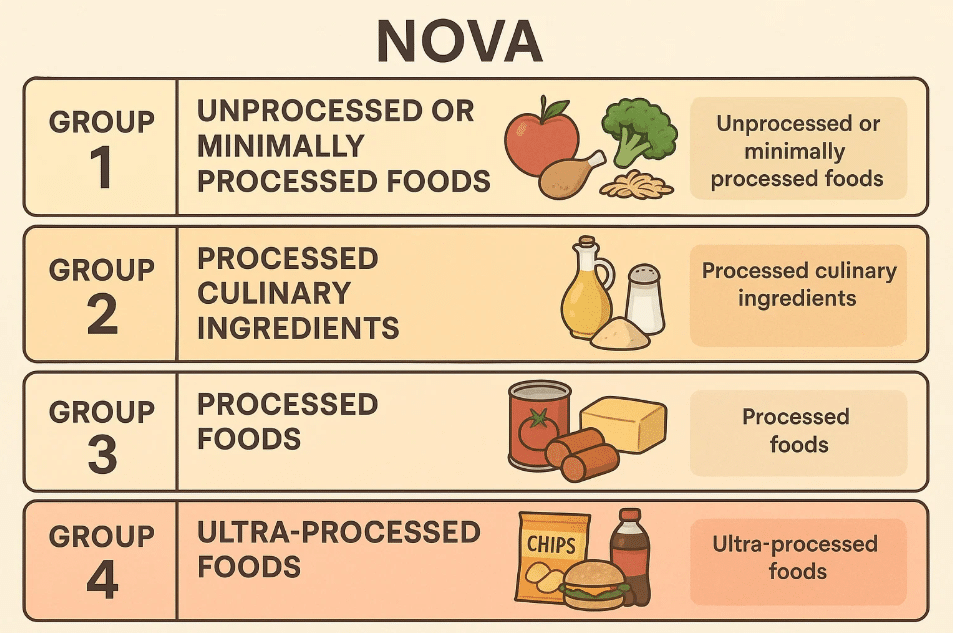
Group four is the ultra-processed group.
Industrial formulations built from ingredients you would never find in a kitchen drawer. Emulsifiers. Protein isolates. Modified starches. Colourings, flavourings, stabilisers.
My test is simple. Read the label. If you cannot buy the ingredients, it was not really cooked. It was assembled.
One caveat before we start…..Wholemeal bread and supermarket hummus sit in the same NOVA box as cola and cheap sausages. Therefore NOVA is not everything.
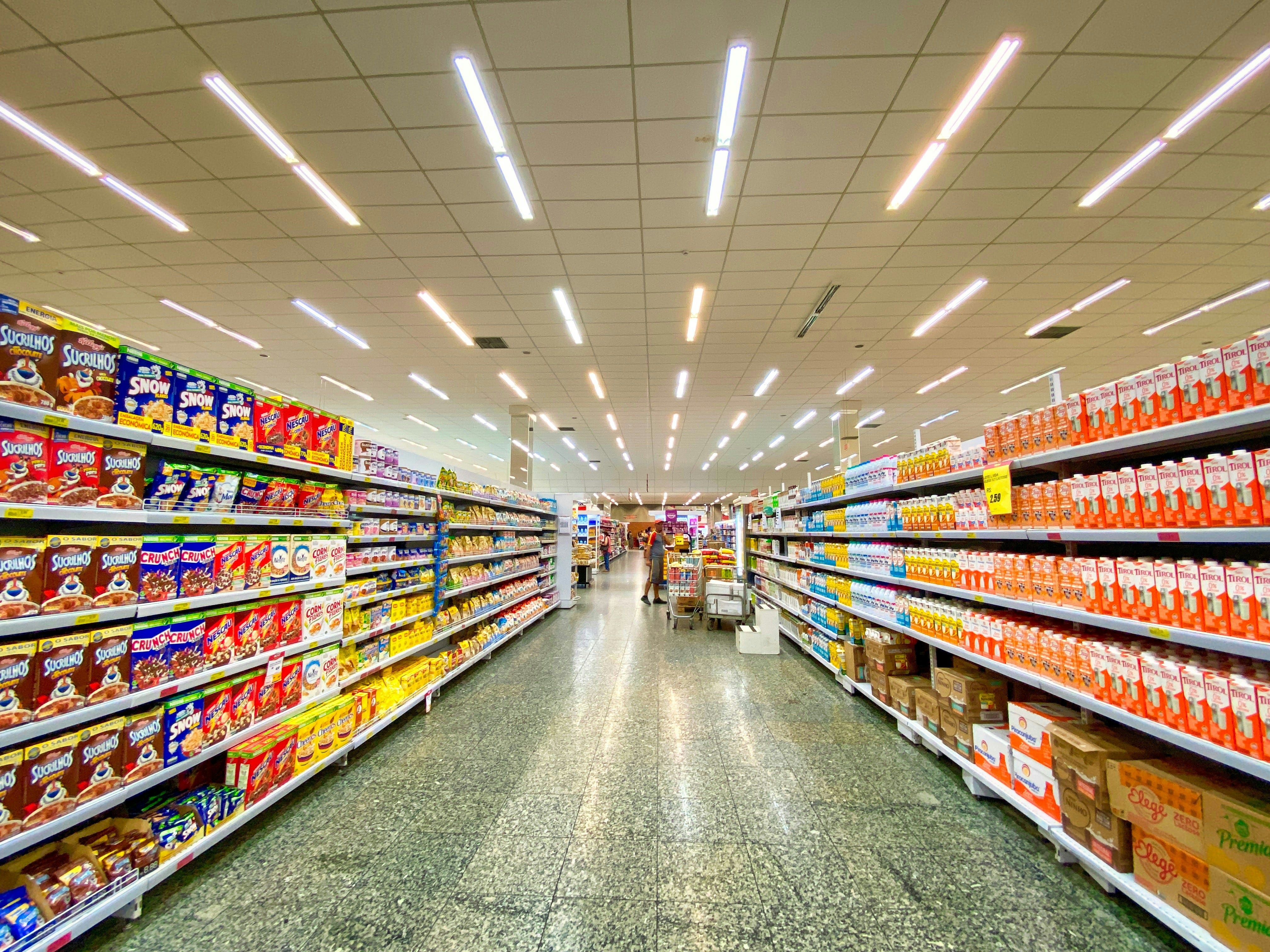
An ultra-processed day…
Be honest….is this you?
Breakfast. Frosted cereal with long-life milk. A cereal bar in the car.
Lunch. A meal deal. White bread sandwich, flavoured crisps, a diet fizzy drink.
Dinner. Ready meal lasagne, garlic bread, ice cream after.
If this is you….you may want to read on!
The culprits
1. Emulsifiers
These keep sauces silky and ice cream creamy.
Carboxymethylcellulose (CMC) is the common one.
In mice, emulsifiers thin the mucus layer that keeps bacteria at a distance from the gut wall, and drive inflammation. Mice, though. Hold the thought please.
In humans we have less evidence.
A randomised controlled feeding trial gave healthy adults a diet with or without CMC for eleven days. The emulsifier group lost microbial diversity, made fewer beneficial metabolites, and reported more abdominal discomfort after meals.
(Please note, LOW sample size. Sixteen people, eleven days.)
2. Artificial sweeteners
In 2022, researchers randomised 120 sweetener-naive adults to saccharin, sucralose, aspartame, stevia or control for two weeks. All below permitted limits.
All four shifted the gut and oral microbiome. Saccharin and sucralose measurably worsened blood sugar responses.
The effect was personal. Some responded, some did not, and the difference lived in their microbes. When the researchers transplanted the responders’ microbiomes into germ-free mice, the mice inherited the response.
Again mice….nothing concrete.
3. Preservatives and nitrites
Processed meat is classified by the IARC as a group one carcinogen, on the evidence of colorectal cancer. Every 50g a day raises risk by around 18%.
Group one describes how sure we are, not how dangerous it is. Tobacco is in that group too, and bacon is not tobacco. The certainty is high. The risk per person is modest.
4. The missing fibre
Ultra-processed food is stripped of fibre almost by design.
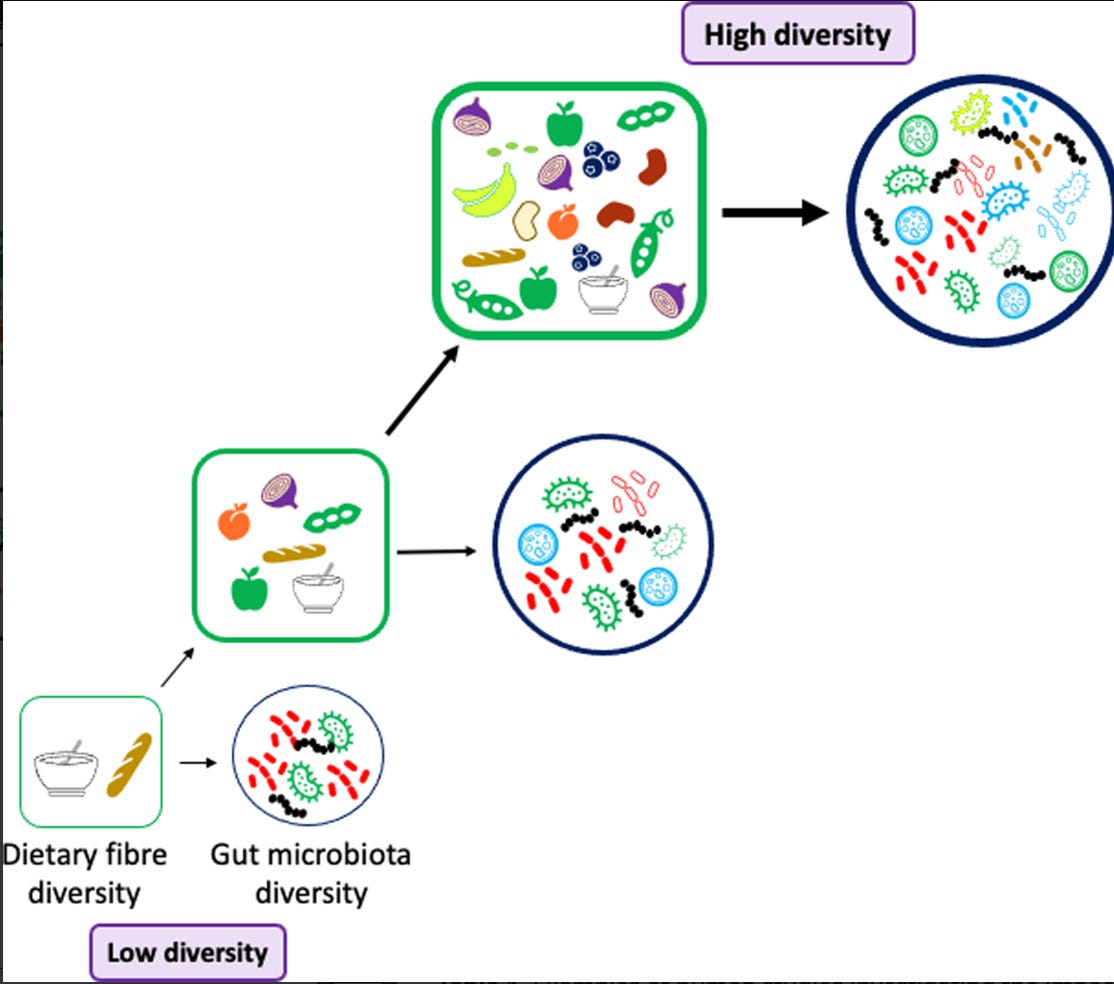
No fibre means an unhappy gut microbiome!
You know how much I LOVE fibre….read here
So what can potentially happen?
The microbiome thins out. Low fibre plus additives means less diversity, fewer butyrate producers, less of the good stuff like Faecalibacterium prausnitzii and Akkermansia muciniphila, and a weaker barrier between you and your bacteria.
Possible mood changes. In 31,172 women followed for fourteen years, the highest ultra-processed intake carried roughly a 50% higher risk of depression. Artificially sweetened drinks carried most of that signal. (However, lots of confounding factors - these women smoked more, moved less and weighed more! The association was adjusted)
Your mouth biome. That sweetener trial changed the oral microbiome as well as the gut one.
Finally an interesting (and small) study. Twenty adults lived on a metabolic ward and ate either an ultra-processed or unprocessed diet for two weeks, then swapped.
The diets were matched for calories offered, fat, sugar, salt and fibre. Participants rated both equally pleasant.
On the ultra-processed diet they ate 508 more calories a day and gained around a kilogram.
Colorectal cancer. Across 206,248 Americans followed for up to 28 years, men in the highest fifth of ultra-processed intake had a 29% higher risk of colorectal cancer, driven by ready-to-eat meat products and sugary drinks. In women, no association at all (not sure why!)
The defence (with the full links)
Fibre. For every 10g a day, colorectal cancer risk falls by about 10%. Feed the bacteria! My full fibre guide is here.
Postbiotics. The simplest way to improve your gut diversity. I wrote about postbiotic foods here.
Polyphenols. An eight week polyphenol-rich diet lowered zonulin, a marker of a leaky gut barrier, in older adults. My flavonoid piece is here.
Probiotics, for some. Not a daily tonic for everyone!
They earn their place in specific situations. Best proven is preventing antibiotic-associated diarrhoea, where a meta-analysis of 36 trials in 9,312 adults found a 38% reduction.
My conclusion
Are ultra-processed foods bad for your gut?
Probably. And honestly, “probably” is the strongest word the evidence allows me.
We know ultra-processed food makes people eat more.
We know processed meats are a risk factor for developing bowel cancer.
The rest, the mood, the microbes, the mucus, sits somewhere between possible/plausible and proven.
So no, you do not need to be perfect. You need to be pointed in the right direction.
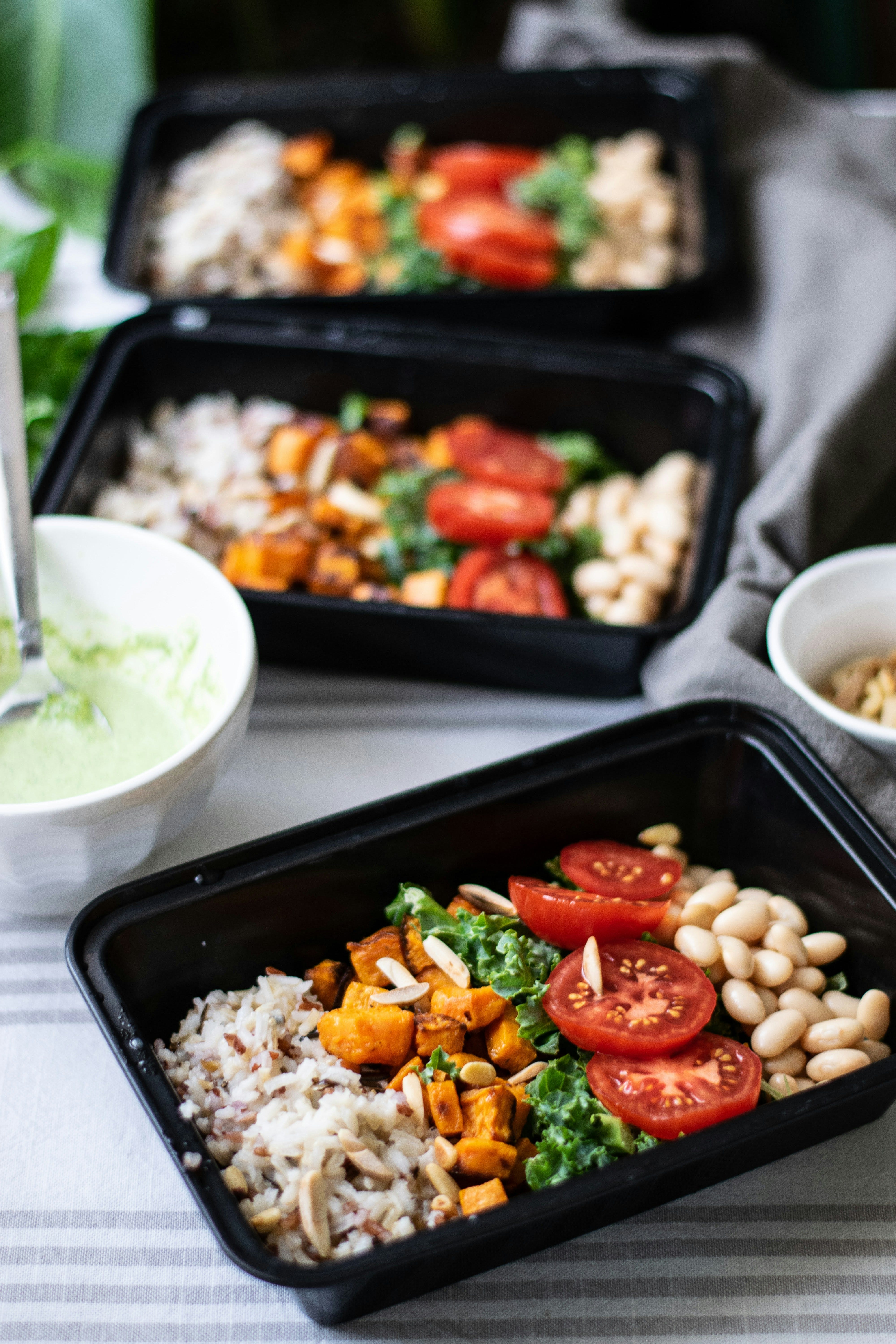
Cook one more meal from scratch this week. Read one more label. Add one more plant. Keep the plate colourful (I’m not talking about lucky charms).
Struggling with liver or digestive issues that affect your daily life? Invest in your gut health with a private, personalised consultation where I will explore your specific symptoms and develop a targeted treatment plan. Take the first step toward digestive wellness today: https://bucksgastroenterology.co.uk/book-an-appointment/ (I offer both in person and video consultations!)
You can check out my full Substack here
References
Monteiro CA, Cannon G, Levy RB, et al. Ultra-processed foods: what they are and how to identify them. Public Health Nutr. 2019;22(5):936-941.
Gupta S, Hawk T, Aggarwal A, Drewnowski A. Characterizing ultra-processed foods by energy density, nutrient density, and cost. Front Nutr. 2019;6:70.
Rauber F, Louzada MLC, Steele EM, et al. Ultra-processed food consumption and chronic non-communicable diseases-related dietary nutrient profile in the UK (2008-2014). Nutrients. 2018;10(5):587.
Chassaing B, Koren O, Goodrich JK, et al. Dietary emulsifiers impact the mouse gut microbiota promoting colitis and metabolic syndrome. Nature. 2015;519(7541):92-96.
Chassaing B, Compher C, Bonhomme B, et al. Randomized controlled-feeding study of dietary emulsifier carboxymethylcellulose reveals detrimental impacts on the gut microbiota and metabolome. Gastroenterology. 2022;162(3):743-756. (RCT, 16 healthy adults, 11 days.)
Suez J, Cohen Y, Valdés-Mas R, et al. Personalized microbiome-driven effects of non-nutritive sweeteners on human glucose tolerance. Cell. 2022;185(18):3307-3328.e19. (RCT, 120 adults, 2 weeks.)
Bouvard V, Loomis D, Guyton KZ, et al. Carcinogenicity of consumption of red and processed meat. Lancet Oncol. 2015;16(16):1599-1600.
Whelan K, Bancil AS, Lindsay JO, Chassaing B. Ultra-processed foods and food additives in gut health and disease. Nat Rev Gastroenterol Hepatol. 2024;21(6):406-427.
Samuthpongtorn C, Nguyen LH, Okereke OI, et al. Consumption of ultraprocessed food and risk of depression. JAMA Netw Open. 2023;6(9):e2334770.
Hall KD, Ayuketah A, Brychta R, et al. Ultra-processed diets cause excess calorie intake and weight gain: an inpatient randomized controlled trial of ad libitum food intake. Cell Metab. 2019;30(1):67-77.e3.
Wang L, Du M, Wang K, et al. Association of ultra-processed food consumption with colorectal cancer risk among men and women: results from three prospective US cohort studies. BMJ. 2022;378:e068921.
Aune D, Chan DSM, Lau R, et al. Dietary fibre, whole grains, and risk of colorectal cancer: systematic review and dose-response meta-analysis of prospective studies. BMJ. 2011;343:d6617.
Wastyk HC, Fragiadakis GK, Perelman D, et al. Gut-microbiota-targeted diets modulate human immune status. Cell. 2021;184(16):4137-4153.e14.
Del Bo’ C, Bernardi S, Cherubini A, et al. A polyphenol-rich dietary pattern improves intestinal permeability, evaluated as serum zonulin levels, in older subjects: the MaPLE randomised controlled trial. Clin Nutr. 2021;40(5):3006-3018.
Liao W, Chen C, Wen T, Zhao Q. Probiotics for the prevention of antibiotic-associated diarrhea in adults: a meta-analysis of randomized placebo-controlled trials. J Clin Gastroenterol. 2021;55(6):469-480.
General Disclaimer
Please note that the opinions expressed here are those of Dr Hussenbux and do not necessarily reflect the positions of Buckinghamshire Healthcare NHS Trust. The advice is intended as general and should not be interpreted as personal clinical advice. If you have problems, please tell your healthcare professional, who will be able to help you. Thank you to the amazing photographers from Unsplash where I get most of my images from.
Once again, greetings from this 81 year old woman who has "never" had any problems with her gut. Because I was born way before "ultra-processed" food was created I am not addicted to it as so many younger people are today.
In my day, coming from a family of fabulous cooks, pretty much everything was made from scratch. Most food back then was organic, long before the word came into vogue.We all, to this day, continue to cook and eat healthy food. None of us, going back to my grandparents, ever had problems with our guts.
I've been a health researcher for decades. I even published a book about reversing the aging process which highlights what we feed our body and why.
Today, my gut is as healthy as it's been over the course of my life; regular bowel movements, my perfect stools are a sight to behold which means I'm feeding my body correctly. Our bodies talk to us given the state of our health; that includes what our lower register is telling us, so pay attention to the signs that can cause lifelong threatening problems.
Eat real food; lots of fiber, fresh fruit and vegetables, minimum sugar and salt. Keep your body hydrated with water, not sugary drinks. It's not rocket science, it's educating yourself about food and health. It's choosing wellness or sickness we age. We choose those things.
My granddaughter knows more than most adults do about how her body works and what to feed it.
I wish more attention to healthy eating was taught in schools, from kindergarten through college.
The corporate food scientists love that you young-uns are sick, addicted to their food (which makes the billionaires richer and y'all sicker). They should be in prison.
Thank you again, Dr. Hussenbux for educating so many about this important subject.
One of the biggest gifts from my mother was teaching me about nutrition. So for me, rarely processed items, no fast food, sodas or sugary anything is the norm. Eating organic food along with other healthy habits has kept me out of the doctor’s office. I say this humbly, because I learned to cook from a very young age thanks to my mum, and that’s where it begins.