

Is matcha good for your gut?
This green powder is everywhere! Here is what you need to know.

Matcha is definitely having a moment.
It is in the coffee shop, on the supermarket shelf, and near the top of every wellness feed, usually wearing the word “gut” like a badge.
The claim is simple: drink this bright green powder, and your microbiome will go super saiyan!
I find this interesting, because the honest answer is not what you may think.
Matcha is neither the next miracle gut cure nor a total fraud.
Let me explain what the evidence shows….
Disclaimer: TLDR….there is limited evidence. Maybe this article becomes redundant after a few months/years once a high powered study comes out. Watch this space.
You can check out my full Substack here
It is (basically) green tea but concentrated
Ordinary green tea is brewed, and the leaf is thrown away.
Matcha is the whole leaf: shade-grown, dried, ground to powder, and drunk in its entirety.
You are not steeping the leaf, you are eating it.
So per cup, (theoretically), matcha delivers more of everything.
More catechins, the polyphenol family that includes EGCG. More caffeine. More theanine. A little insoluble fibre too.
Those catechins are why matcha is pivoted towards being “gut healthy”.
They are poorly absorbed in the small bowel, which sounds like a flaw but is the whole point.
Largely unabsorbed, they travel down to the colon, where your bacteria set to work on them.
What’s the evidence??
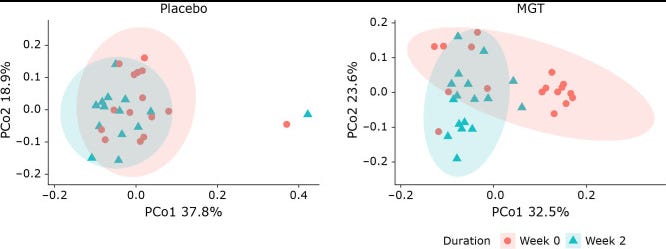
A randomised, double-blinded trial gave healthy young adults matcha twice daily for two weeks.
The matcha group showed a significant shift in microbial diversity. The placebo group showed none.
A systematic review pulling the human and animal work together points the same way: matcha may nudge the microbiome by encouraging beneficial bacteria such as Bifidobacterium, Lactobacillus and Akkermansia (generally speaking, “good” bugs).
It is genuinely promising but preliminary.
The trials are small, short, and measured in weeks rather than years.
They suggest that matcha may change the microbiome. They do not yet show that it improves your health, and those are not the same sentence.
So the fair summary is this. Plausible mechanism, early human signal, no proof of clinical benefit. Interesting, not established.
Some caveats
Two practical points….
First, caffeine. Matcha carries a meaningful dose, often more than a cup of tea. For most people that is fine, even pleasant.
But if you live with reflux, an unpredictable bowel habit, or anxious, sensitive digestion, caffeine can stir all three. (Drink it in the morning, IMO).
Second, the drink and the supplement are not the same thing.
Drinking matcha is safe.
Swallowing concentrated green tea extract capsules is a different proposition.
A United States Pharmacopeia review linked liver injury to green tea extract, with cases reported across EGCG doses from 140 mg up to around 1000 mg a day, and wide variation in individual susceptibility.
The risk climbs when extracts are taken in large bolus doses on an empty stomach.
European regulators concluded that drinking green tea is relatively safe, but that supplemental catechins above 800 mg a day may pose a risk of liver injury. If you take one thing from this piece, let it be that. Enjoy the drink and SKIP the capsule.
A final note for anyone watching their iron.
The tannins in matcha bind non-haem iron, the plant form, and reduce its absorption.
If your levels run low, keep the matcha away from your meals rather than with them.

My conclusion
Is matcha good for your gut?
It is probably mildly favourable, plausibly prebiotic, and very unlikely to do harm in moderation.
What it is not, on current evidence, is a treatment, a cure, or a reason to change anything important about your life.
Drink it because you enjoy the ritual and the gentle lift.
Drink it because the aesthetic is cool and the moment is calm.
The science may yet catch up with the hype.
Struggling with liver or digestive issues that affect your daily life? Invest in your gut health with a private, personalised consultation where I will explore your specific symptoms and develop a targeted treatment plan. Take the first step toward digestive wellness today: https://bucksgastroenterology.co.uk/book-an-appointment/ (I offer both in person and video consultations!)
You can check out my full Substack here
References
Effect of matcha green tea on human faecal microbiota: a randomised, double-blinded study. 2022 RCT, 33 healthy adults, 2 weeks.
Matcha Tea Quality and Functional Effects on Gut Microbiome: A Comprehensive Systematic Review. Food Reviews International, 2026.
Microbial-Transferred Metabolites and Improvement of Biological Activities of Green Tea Catechins by Human Gut Microbiota. Foods 2024;13(5):792.
Hu J et al. United States Pharmacopeia (USP) comprehensive review of the hepatotoxicity of green tea extracts. Toxicol Rep 2020.
EFSA Panel. Scientific opinion on the safety of green tea catechins. EFSA Journal 2018.
General Disclaimer
Please note that the opinions expressed here are those of Dr Hussenbux and do not necessarily reflect the positions of Buckinghamshire Healthcare NHS Trust. The advice is intended as general and should not be interpreted as personal clinical advice. If you have problems, please tell your healthcare professional, who will be able to help you. Thank you to the amazing photographers from Unsplash where I get most of my images from.
Great stuff as ever...
Thanks for the information. Always value your input.